Showing posts with label art house. Show all posts

Friday, April 19, 2013

Three Colors Trilogy (Blue / White / Red) (1994) Review

Three Colors Trilogy (Blue / White / Red) (1994)
Average Reviews:

(More customer reviews)
The late great Polish director Krzysztof Kieslowski cleverly "adapted" the three French ideals -- liberty, equality, fraternity -- into three thought-provoking modern-day dramas about people who cope with personal losses and tragedies. In BLUE, the first of the trilogy, a widow tries to set herself free (and gain liberty) from her emotional baggages. The second film, WHITE, is about a jilted man's outrageous plot to get even (thus, equality) with his ex-wife. The last film, RED, which is also Kieslowski's final film before he died in 1996, is about a lonely old man who is embittered by the memories of his youth and finds accidental companionship (fraternity) with a young model. All three films are understated in their tone, economical in their dialogs, elliptical in their editing and plotting (there are some mind-boggling flashbacks and flash forwards in WHITE), and haunting in their atmosphere.
The references to the three French ideals are actually quite tenuous, and in fact more and more so as the trilogy progresses. BLUE is the only one that deals with the ideal of "freedom" (albeit emotional freedom) in a concrete way, inviting us to ponder its meanings and its attainability. WHITE treats the concept of "equality" in a rather subversive and satiric way, and it clearly wants us to rethink its meanings rather than accepting it at face value. And RED has to do with "fraternity" only circumstantially, and has more to do with the issue of destiny, and how our past is linked to our present. The three films are set not just in France, but also in Poland and Switzerland, and WHITE has primarily Polish dialogs. Hence, a sort of universality is intended.
The three films are also linked in various ways. All three films involve an unfaithful lover who dies, in one way or another. All three films involve a chance encounter between the distressed protagonist and a sympathetic observer -- the widow and the mistress in BLUE, Karol and Mikolaj in WHITE, the retired judge and the model in RED. Both BLUE and WHITE are about people who move to new surroundings to escape from his or her troubled pasts. And RED, ironically, is about someone who never leaves his home in order to wallow in his self-pity.
Kieslowski had done this sort of thing before. In 1988, he "adapted" the Ten Commandments into ten one-hour, modern-day dramas, collectively titled DECALOGUE, that make us rethink the meanings of the commandments. In the segment for "Thou Shalt Not Steal," for instance, we witness the kidnapping (the theft) of a child from her adopted parents by her natural mother, who thinks she has a right to her custody. Thus, it turns clear-cut moral ideals into real-world dramas that have no clear-cut solutions or judgments.
Miramax released long-awaited Region-1 DVDs for the Three Colors trilogy, and they all have superb video transfers and rewarding extra material. Kieslowski expert Annette Insdorf provides excellent running commentaries for all three films. She analyzes the visual, aural, and editorial techniques, the thematic significance, as well as how the final films deviate from their original screenplays. She points out that Kieslowski films often deal with abstract concepts, such as fate, death, and grief, in very concrete ways. She makes an observant remark about the apparent twist of fate in the opening of BLUE: if the hitchhiker were picked up by the family, the ensuing tragedy might not occur. She points out that the dream-like wedding scene in WHITE, which many assume is a flashback, could also be a flash forward (a very interesting, and plausible, notion). She offers her interpretations to the many symbolisms in the films, such as the frequent fades to black in BLUE, the recurring shot of a stooped old person at a garbage bin, the significance of the concerto music in BLUE, the tango theme in WHITE, and the bolero score in RED. She also explains the intentionally cryptic endings of WHITE and RED.
Each disc comes with several featurettes that comprise about 100 minutes of interviews and commentaries by the cast and crew, Insdorf, film critic Geoff Andrew, and film director Agnieszka Holland. The BLUE and WHITE discs also contain some early short films by Kieslowski: CONCERT OF WISHES, THE TROLLEY, THE FACE, THE OFFICE. All three discs contain a fascinating segment called "Kieslowski's Cinema Lesson," in which the director explains his intentions in one particular scene. The WHITE and RED discs contain behind-the-scenes footage of Kieslowski giving directions on the set. For Kieslowski fans, perhaps the most poignant clip in these supplements is that of Kieslowski announcing his retirement at the '94 Cannes festival, included on the RED disc.

Click Here to see more reviews about: Three Colors Trilogy (Blue / White / Red) (1994)

Miramax Home Entertainment is proud to present BLUE, WHITE and RED, the acclaimed films by director Krzysztof Kieslowski. Hailed by filmgoers as some of the most absorbing, engaging, well-crafted dramas in recent memory, the box set of BLUE, WHITE and RED Each DVD disc includes lengthy bonus features. BLUE: Academy Award winner Juliette Binoche ("The English Patient," Best Supporting Actress, 1996) stars as a young woman left devastated by the unexpected death of her husband and child. She retreats into the world around her, but is soon reluctantly drawn into an ever-widening web of lies and passion as the dark, secret life of her husband begins to unravel. WHITE: Sexy Julie Delpy ("Before Sunrise") stars in a mysterious tale of a man whose life disintegrates when his beautiful wife of six months deserts him. Forced to begin anew, he rebuilds his life, only to plan a dangerous scheme of vengeance against her. Winner of the Best Director Award at the Berlin Film Festival. RED: Irene Jacob ("The Double Life of Veronique") stars as a young model whose chance meeting with an unusual stranger leads her down a path of intrigue and secrecy. As her knowledge of the man deepens, she discovers an astonishing link between his past and her destiny.

Buy Now

Click here for more information about Three Colors Trilogy (Blue / White / Red) (1994)

Sunday, April 7, 2013

Andrzej Wajda - Three War Films (A Generation, Kanal, and Ashes & Diamonds) - Criterion Collection (1961) Review

Andrzej Wajda - Three War Films (A Generation, Kanal, and Ashes and Diamonds) - Criterion Collection (1961)
Average Reviews:

(More customer reviews)
I have not seen A Generation, the first film in this box set, but I have seen the others. I felt compelled to write a review, because there was none so far and I wouldn't want anyone to be turned off from these films due to ignorance. I am half-Polish and have visited the country half a dozen times since I was a little boy. What struck me most about Poland when I visited as a young man, was the kindness people expressed to each other, even if they were complete strangers. I asked an older woman for directions in the street and she pulled me close and put her arm around me in a motherly way, pointing in the direction I needed to go. The fact that such kindness and humanity have persisted under decades of oppressive totalitarian rule seems both ironic and appropriate. It's as if the more Stalin beat down on the Polish people, the more resilient and warm-hearted they became. Knowing Polish people helps you understand their films. But, not everyone interested in Wajda can have that luxury, so I will try to give you a summary in a way you would relate to.
Kanal is a very compelling film, very accessible to American audiences. It is taut, suspenseful and portrays the WWII conflict from a perspective I think many Americans will be unfamiliar with. Much of the film takes place in a sewer, as the refugees try to find an escape from certain death at the hands of the Nazis. Fans of claustrophobic thrillers will appreciate this. The atmosphere is almost choking at times. It's a powerful experience. Steven Spielberg revealed in an interview that he screened Wajda's war films to his crew in preparation for Saving Private Ryan, to give them a better sense of how to create the mise-en-scene of war torn Europe. Kanal contains some virtuosic camera work that should be of interest to any serious film student.
Ashes and Diamonds is a monumental film, probably the most important in all of Polish cinema. (the only other one that comes close is Wajda's Man of Iron, winner of the Golden Palm in 1981). Zbigniew Cybulski is the antic, nervy hero, indeed a James Dean-like persona. Tragically, Cybulski also died young, missing a step while hopping onto a moving train, he fell and was crushed. Ashes and Diamonds will be of most significance to those familiar with the politics of the time and place. It's not an easy film. In fact, it's heartbreaking. But the staggeringly honest portrayal of conflicted allegiances to government and one's soul will resonate with all who see it. A man is hired to assassinate another man. A simple story treated realistically, with all the second guessing and anguish a real person would feel. The Polish sense of compassion extends even to her enemies.
The cover art on this box set depicts a blood soaked bed sheet flapping on a clothesline. When I visited Poland, white sheets drying on clotheslines was a common sight, be it a rural or urban area. But beyond the evocation of war and bloodshed, the red blood has another significance. Red and White make up the bi-colored Polish flag, which closely resembles the bedsheet in the graphic. It is a symbol of Poland's bloody history and the traumatic turmoil of this period in time.
This box set and Kieslowski's the Decalogue comprise a healthy chunk of the brilliant cinema found in Poland, a country with one of the earliest and most successful film schools in the world.

Click Here to see more reviews about: Andrzej Wajda - Three War Films (A Generation, Kanal, and Ashes & Diamonds) - Criterion Collection (1961)

In 1999, Polish director Andrzej Wajda received an Honorary Academy Award(r)for his body of work-more than thirty-five feature films, beginning with A Generation in 1955. Wajda's second film, Kanal, the first ever made about the Warsaw uprising, secured him the Special Jury Prize at Cannes and started him on the path to international acclaim, secured with the releases of his masterpiece, Ashes and Diamonds in 1958. These three groundbreaking films ushered in the "Polish School" movement and later became known as the "War Trilogy." But each boldly stands on its own-a testament to the resilience of the human spirit, the struggle for personal and national freedom, and Wajda's unique contribution to homeland and world cinema. The Criterion Collection is proud to present this director-approved edition, with new transfer of all three films and extensive interviews with the director and his colleagues.

Buy NowGet 10% OFF

Click here for more information about Andrzej Wajda - Three War Films (A Generation, Kanal, and Ashes & Diamonds) - Criterion Collection (1961)

Tuesday, January 29, 2013

Christmas Evil (1980) Review

Christmas Evil (1980)
Average Reviews:

(More customer reviews)
Christmas Evil holds a unique spot in the genre of Christmas slasher films. While a few individuals are murdered, there so little blood that I would not classify this as a slasher film at all. This is more of a psychological treatment that transcends horror of a primal nature. In its own special twisted way, Christmas Evil is really sort of touching, and I would argue that it actually does possess a measure of real Christmas spirit. Harry isn't a bad guy; his heart is in the right place - it's just a few of his toys of death that end up in wrong places such as someone else's neck. As a young child, Harry sees disturbing evidence before his very eyes that Santa Claus is not real, and this experience scars him for life. He does not let the Christmas spirit die in him, however; the spirit actually grows to the point that, as a forty-something year old man, he tries to become Santa Claus and spread joy to good little children. He spies on the neighborhood kids, writing down notes in his books of naught boys and girls. As a newly-promoted manager at a toy factory, he is dismayed to see inferior-quality toys rolling off the assembly line, his co-workers speak badly of the holidays, and a new hotshot executive puts forth a promotional campaign to send toys to a children's hospital without knowing or caring if there will be enough for the kids. Eventually, poor Harry snaps, dons a Santa suit, and goes out to spread Christmas spirit all around. Of course, a few adults have been very bad in his eyes, and a few of them end up dead.
Brandon Maggart is really quite good in the role of Harry. Some of his laughing fits early on are rather annoying, but his face really shows a lot of emotion and complexity, especially on those occasions when he is doing something that will make children happy and when he finally comes to grip with the idea that his plan to give everyone a real Santa has failed. Take away Harry's obvious mental unbalance and you are left with a weird sort of inspirational story, one that actually fits in to some degree with classic Christmas tales such as A Christmas Carol. I'm not saying this is a movie every family needs to watch every Christmas Eve - that is clearly not the case. However, Harry, in his own tragically disastrous way, does have the Christmas spirit and tries to keep it in his heart every single day, and that is what I will remember about him the most.

Click Here to see more reviews about: Christmas Evil (1980)


Harry Stadling (Brandon Maggert) is obsessed with Christmas! In fact he wants to "be" the authentic Santa Claus, with a real suit, sleigh and reindeer. Ever since he learned the "truth" about Santa, he's tried to make Christmas a reality.Growing up a toy maker, Harry is met with naysayers and critics who mock him for his yuletide beliefs. but he wants people to get the presents they deserve, even if that means giving the gift of murder! Cynics and uptight hypocrites beware! Lewis Jackson's classic black comedy horror film, CHRISTMAS EVIL (aka YOU BETTER WATCH OUT!) is, according to cult film director/auteur John Waters, "the best seasonal film of all time. I wish I had kids.I'd make them watch it every year and, if they didn't like it, they'd be punished!"
Time to hang those stockings from the fireplace and get ready. the sadistic holiday chestnut CHRISTMAS EVIL is here in an all-new "Director's Cut" edition.Transferred from the director's own personal film elements, this version of CHRISTMAS EVIL is the original first cut of the film containing even more scenes and never-before-seen footage!

Buy NowGet 28% OFF

Click here for more information about Christmas Evil (1980)

Saturday, July 7, 2012

Zabriskie Point (2009) Review

Zabriskie Point (2009)
Average Reviews:

(More customer reviews)
I give this move 5 stars for personal reasons. If you peer ever so closely at the panoramic 'orgy in the desert' shot, you will see me groaning with "her" in the sand. While there was no actual fornicating going on within my range of vision, I can tell you the gal next to me was asking out loud for it! Damn! I miss those incredibly naive, self-indulgent days. It was, I believe, October of 1968 and I was a senior in a Las Vegas high school. I answered the casting call for extras. Miracously, my father allowed me to miss a week of school to "train" with a feely-touchy dance troupe from NY. When shooting started MGM would bus us from Vegas to the Point every morning at 5am. Most of my time on the set was spent gawking at Diana, Antonioni, and all the wild movie equipment. They even imported fine silk sand to blow around. I guess Death Valley sand was not european enough. I remember Antonioni, in full archetypical director mode, chasing Mark F. off the sound set for laughing at our feeble attempts to create "love noises" for the orgy scene. HA! The setting was surreal, the weather incredible, the catered lunch edible, and the young ladies sensuous and willing in that 60's way. You know how you sometimes fantasize about going back to a time in your life that was almost perfect? Well, this is one of those times for me.
Oh, I read the Time Magazine review when the movie came out and the reviewer said, "The moral of the story? Don't help a good boy go bad. Lock your airplane, take your keys." Since I wrote that "review" back in 1991 I had occasion to revisit Zabriskie's Point (the place, not the movie). It was my 50th birthday and my wife treated me to a stay at the famous Furnace Creek Inn.
We went over and it was as I remember it. Stunning. The only change was the parking/view area. You can no longer just drive on in to the canyons as the catering truck did back in 1968. So, while I am 'pointing and pondering' these three beautiful ladies arrive. They are talking away in some Euro language and I hear, "Antonioni". I say, "you know the movie?"
"Yes, we came to Death Valley just to see this place."
I say, "I was there when the movie was filmed".
They all came unglued and plied me with questions. Had to have a photo. My wife was bemused, to say the least. For a moment, I was once again Making Love, Not War.
I am just realizing what an effect this movie has had on so many people and how lucky I was to be even a small part of it.
The real miracle of it all is that my father let a 17 year old wanna-be hippie skip a week of school to bounce around Death Valley with a bunch of radicals. Another odd thing was that I had recently sworn off drugs and alcohol so I got to be totally "present" for the experience. From my observation, I may have been the only sober participant...!

Click Here to see more reviews about: Zabriskie Point (2009)

In a story of youthful rebellion, a young man steals an airplane and flies over the desert, where he meets a young woman and falls in love.

Buy NowGet 20% OFF

Click here for more information about Zabriskie Point (2009)

Thursday, July 28, 2011

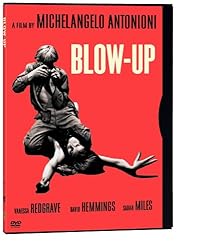
Blow Up (1966) Review

Blow Up (1966)
Average Reviews:

(More customer reviews)
Michelangelo Antonioni's view of Britain in the 1960's was a groundbreaking film that appeared at a time of turmoil and change in the lifestyles and mores of the Western world. Britain ruled supreme in pop music (Beatles, Stones, Animals) and in fashion (Mary Quant, Twiggy, Carnaby Street). The jazz stylings of Herbie Hancock were used as the soundtrack for the film, but the live Rock performance in the film was performed by the post-Clapton Yardbirds with Jeff Beck and Jimmy Page. To reflect the London fashion scene, Antonioni used the German model Verushka in a simulated photo shoot that has been called the sexiest scene in film history.
(As an aside, Verushka's real name was Vera and her father was one of the German army officers who attempted to assassinate Hitler in 1944; with the failure of the plot, he was executed and his family was interred in labor camps.)
When I first viewed this film in 1967, I was enormously impressed. The photography was brilliant and the audio was the first "surround-sound" I had ever encountered. (During the park scenes, I kept looking over my shoulder to see what birds had gotten into the theater!) When I again saw this film about 1975, it looked dated and out of fashion. Now, more than 40 years later, I see that it is a true period film that reflects much of the character and thinking of the time.
David Hemming's character in the movie (known as "Thomas") is not satisfied with his success as a fashion photographer and wants to become a "reality/documentary" photographer in the genre of Dorthea Lange or Henri Cartier-Bresson. To this end, he pretends to be a street person and spends a night in a doss house, a sort of cheap barracks accommodation with shared sleeping and bath facilities. Thomas sneaks his camera into this establishment in a paper bag and surreptitiously photographs the other guests as they shower and dress in the morning. The clicking and whirring sounds of his camera and the stop-action showing the photographs that were produced constituted the opening scenes of "Blow-Up". Thomas intends to use these and other such photographs in a book that he hopes will establish him as a "real" photographer. For some incomprehensible reason, this entire opening sequence has been deleted from the Turner/MGM DVD release. Instead, the movie opens with Thomas leaving the doss house in the morning, after the original opening photography sequence. In the original movie, Thomas then returns to his parked Rolls-Royce, places his camera in the glove box and drives away. We viewers are surprised; is he stealing the car? This scene has also been deleted. In this DVD release, he suddenly and inexplicably appears, already driving the Rolls down the street.
With the deletion of the movie's opening scenes, it is difficult to make sense of some of the later scenes in the film. At one point, Thomas meets with his publisher (an early appearance by Peter Bowles, later known for his performances in "Rumpole of the Bailey", "To the Manor Born" and "The Irish RM") and reviews the photographs he had taken at the doss house. This is the only brief chance viewers of the DVD have to see anything of the opening scenes.
Those opening scenes are important because they set the theme of the film. Thomas first appears as a down-and-out man, but turns out to be far from it. Viewers are put on notice that they can never be sure what is real and what is make-believe. This continues through the film's final scene, where the make-believe of the mimes' tennis game becomes more real than the murder that Thomas accidentally photographed.
The DVD is marred by additional deletions. Thomas develops the roll of film he shot in the park, studies the photos and sees something. (We viewers never really see what it is.) He makes a series of larger and progressively blurrier enlargements. Finally, he makes his largest blow-up, examines it, and instead of hanging it out in the open as he had the others, he conceals it between a pair of cabinets. This seems a fairly long sequence in the original film and it is only later that we learn of its significance. Of course, the name of the film comes from this scene. I can only assume that Turner/MGM felt this sequence was boring and deleted most of it from the DVD. When Thomas later finds his studio has been robbed, we don't even know what was taken or why he has this one enlargement left. There are other odd little deletions here and there in the DVD; perhaps there were some bad frames in the original film from which the DVD was made. When I purchased the DVD, I expected some of his romp with the two young "wanna be" models to be deleted. I did not expect the evisceration of the basic theme of the film by the deletion of the important opening scenes.
I might describe this DVD as a "Bowdlerised" edition, but perhaps "Turnerized" may be more correct. The DVD includes commentary by Peter Brunette, an academician. author and presumed expert on the films of Michelangelo Antonioni. I have carefully listened to his commentary twice through, and can only conclude that he never saw the original film. His comments refer only to this DVD edition. At one point in his commentary, Mr. Brunette notes that the clothes worn by Thomas at the doss house mysteriously disappear. Yes they do, because of another nonsensical deletion!
I would not normally recommend a DVD with so many deletions, but it seems that this flawed DVD is the only version of the film that is currently available. To see it in this form is better than to not see it at all. I give it 3 stars instead of the 4+ that the original film deserves.

Click Here to see more reviews about: Blow Up (1966)

Taking photographs of a couple making love proves deadly when the photographer enlarges the image and discovers murder.The film and pictures are stolen from his studio and the body vanishes.In this elegant balance of deciet and trickery, the photographer must question the reality of what he has actually seen.

Buy Now

Click here for more information about Blow Up (1966)