Showing posts with label criterion collection. Show all posts

Sunday, April 7, 2013

Andrzej Wajda - Three War Films (A Generation, Kanal, and Ashes & Diamonds) - Criterion Collection (1961) Review

Andrzej Wajda - Three War Films (A Generation, Kanal, and Ashes and Diamonds) - Criterion Collection (1961)
Average Reviews:

(More customer reviews)
I have not seen A Generation, the first film in this box set, but I have seen the others. I felt compelled to write a review, because there was none so far and I wouldn't want anyone to be turned off from these films due to ignorance. I am half-Polish and have visited the country half a dozen times since I was a little boy. What struck me most about Poland when I visited as a young man, was the kindness people expressed to each other, even if they were complete strangers. I asked an older woman for directions in the street and she pulled me close and put her arm around me in a motherly way, pointing in the direction I needed to go. The fact that such kindness and humanity have persisted under decades of oppressive totalitarian rule seems both ironic and appropriate. It's as if the more Stalin beat down on the Polish people, the more resilient and warm-hearted they became. Knowing Polish people helps you understand their films. But, not everyone interested in Wajda can have that luxury, so I will try to give you a summary in a way you would relate to.
Kanal is a very compelling film, very accessible to American audiences. It is taut, suspenseful and portrays the WWII conflict from a perspective I think many Americans will be unfamiliar with. Much of the film takes place in a sewer, as the refugees try to find an escape from certain death at the hands of the Nazis. Fans of claustrophobic thrillers will appreciate this. The atmosphere is almost choking at times. It's a powerful experience. Steven Spielberg revealed in an interview that he screened Wajda's war films to his crew in preparation for Saving Private Ryan, to give them a better sense of how to create the mise-en-scene of war torn Europe. Kanal contains some virtuosic camera work that should be of interest to any serious film student.
Ashes and Diamonds is a monumental film, probably the most important in all of Polish cinema. (the only other one that comes close is Wajda's Man of Iron, winner of the Golden Palm in 1981). Zbigniew Cybulski is the antic, nervy hero, indeed a James Dean-like persona. Tragically, Cybulski also died young, missing a step while hopping onto a moving train, he fell and was crushed. Ashes and Diamonds will be of most significance to those familiar with the politics of the time and place. It's not an easy film. In fact, it's heartbreaking. But the staggeringly honest portrayal of conflicted allegiances to government and one's soul will resonate with all who see it. A man is hired to assassinate another man. A simple story treated realistically, with all the second guessing and anguish a real person would feel. The Polish sense of compassion extends even to her enemies.
The cover art on this box set depicts a blood soaked bed sheet flapping on a clothesline. When I visited Poland, white sheets drying on clotheslines was a common sight, be it a rural or urban area. But beyond the evocation of war and bloodshed, the red blood has another significance. Red and White make up the bi-colored Polish flag, which closely resembles the bedsheet in the graphic. It is a symbol of Poland's bloody history and the traumatic turmoil of this period in time.
This box set and Kieslowski's the Decalogue comprise a healthy chunk of the brilliant cinema found in Poland, a country with one of the earliest and most successful film schools in the world.

Click Here to see more reviews about: Andrzej Wajda - Three War Films (A Generation, Kanal, and Ashes & Diamonds) - Criterion Collection (1961)

In 1999, Polish director Andrzej Wajda received an Honorary Academy Award(r)for his body of work-more than thirty-five feature films, beginning with A Generation in 1955. Wajda's second film, Kanal, the first ever made about the Warsaw uprising, secured him the Special Jury Prize at Cannes and started him on the path to international acclaim, secured with the releases of his masterpiece, Ashes and Diamonds in 1958. These three groundbreaking films ushered in the "Polish School" movement and later became known as the "War Trilogy." But each boldly stands on its own-a testament to the resilience of the human spirit, the struggle for personal and national freedom, and Wajda's unique contribution to homeland and world cinema. The Criterion Collection is proud to present this director-approved edition, with new transfer of all three films and extensive interviews with the director and his colleagues.

Buy NowGet 10% OFF

Click here for more information about Andrzej Wajda - Three War Films (A Generation, Kanal, and Ashes & Diamonds) - Criterion Collection (1961)

Thursday, March 7, 2013

Pierrot le Fou (The Criterion Collection) (1965) Review

Pierrot le Fou  (The Criterion Collection) (1965)
Average Reviews:

(More customer reviews)
My exposure to Godard films were through VHS tapes. I was too young to watch his 60's films in their original formats. The transfer is not too great but good enough. The colors are right, it is thankfully letterboxed, etc. even if there are a few image distortions, artifacts and the sharpness and overall quality leaves a lot of room for improvement. There is something very wrong, however, with the sound especially towards the fifth chapter (that's the 5th access in the chapter search of which there are only 6 - thanks to Fox/Lorber!) Thankfully, this is a subtitled film (can't be switched off/on, they're pasted on the screen) otherwise, even the French won't understand the French dialogue. The noise distortion is terrible, but could it be Godard's deliberate way to convey sound since it is the part in which the CB radios or walkie-talkies were being used in the scene? My impression is that the technician in charge was probably asleep or didn't care when this noise distortion was taking place and the DVD didn't go through quality control which could have fixed it. I haven't seen the original so I don't know but since this is a Godard film, anything goes. But then the distortion continued even after that scene so any reasoning to defend Fox's negligience on this matter proved futile. I found it terribly distracting and I thought it pulled down the quality all the more of this already mediocre DVD transfer. Is this the best version yet? How does the VHS version rate? Fox/Lorber is hit and miss with DVDs. They did good with Seven Beauties, Last Year at Marienbad, and the already LD Criterion-restored Umbrellas of Cherbourg and 400 Blows but did very poorly with A Woman is a Woman, several Truffaut films and even the relatively recent Padre Padrone. What a shame that a company like Fox/Lorber gets the rights to release these great Foreign films but doesn't have the interest to come up with quality transfers. I think this is a waste of our hard-earned money to buy the DVDs that they produce. Next time you buy from Fox/Lorber, read the reviews... otherwise just rent or wait for a better re-release in the future.

Click Here to see more reviews about: Pierrot le Fou (The Criterion Collection) (1965)

Dissatisfied in marriage and life, Ferdinand (Jean-Paul Belmondo) takes to the road with the babysitter, his ex-lover Marianne Renoir (Anna Karina), and leaves the bourgeoisie behind. Yet this is no normal road trip: genius auteur Jean-Luc Godard s tenth feature in six years is a stylish mash-up of consumerist satire, politics, and comic-book aesthetics, as well as a violent, zigzag tale of, as Godard called them, the last romantic couple. With blissful color imagery by cinematographer Raoul Coutard and Belmondo and Karina at their most animated, Pierrot le fou is one of the high points of the French new wave, and one last frolic before Godard moved ever further into radical cinemaSpecial Features * - SPECIAL EDITION DOUBLE-DISC SET FEATURES: * - New, restored high-definition digital transfer, approved by cinematographer Raoul Coutard * - New video interview with actor Anna Karina * - A "Pierrot" Primer, a new video program with audio commentary by filmmaker Jean-Pierre Gorin * - Godard, l'amour, la poésie, a fifty-minute French documentary about director Jean-Luc Godard and his work and marriage with Karina * - Archival interview excerpts with Godard, Karina, and actor Jean-Paul Belmondo * - Theatrical trailer * - New and improved English subtitle translation * - PLUS: A booklet featuring a new essay by critic Richard Brody, a 1969 review by Andrew Sarris, and a 1965 interview with Godard

Buy Now

Click here for more information about Pierrot le Fou (The Criterion Collection) (1965)

Monday, February 18, 2013

The Seventh Seal - Criterion Collection (1958) Review

The Seventh Seal - Criterion Collection (1958)
Average Reviews:

(More customer reviews)
This is the film that transformed me from a fan of movies to a lover of cinema. I have probably seen this film more than any other single one - certainly over a dozen times over the years. Some of the Amazon customer reviewers felt the film moved too slowly, or was not stimulating enough in black and white. For such moviegoers this film is definitely not for you. However, for those who enjoy films that speak on many different levels and provoke thoughts that linger with the viewer, this is a masterpiece.
The action takes place in Europe after the crusades. A knight, Antonius Bloch, is returning to his home in Denmark. He is accompanied by his squire. Block is an idealist who joined the crusades because he wanted to do something significant in his life. However the crusades turned out to be completely disillusioning. On his journey he notes that the plague is sweeping across the land. Superstition reigns, along with a severe version of religion. His squire is not as bothered by what he has seen, having been much more cynical all along. Still, the squire has a strong sense of justice that is demonstrated when he saves a girl from an attack.
Along the way a number of people join with the knight for protection. These include a troupe of actors, a blacksmith and his faithless wife, and the woman the squire rescued. Death is lurking, and confronts the knight, informing him that his time has expired. The knight protests that he cannot die before having accomplished something significant. Death says, "They all say that," but the knight insists, and successfully challenges Death to a chess match. This gives the knight additional time to make his life worthwhile.
The knight has tried to accomplish the BIG act based on a profound sense of life and of God. The juggler and his wife have a much simpler idea of life, God, and goodness. As Death is on the verge of winning the chess match and taking everyone in the knight's party, the juggler wakes his wife and child to flee. The knight recognizes that the juggler has seen Death, and upsets the chessboard to distract his opponent. This gives the juggler just enough time to escape. Death asks the knight whether the delay was worth it, and the knight gives an enigmatic smile. He has accomplished his worthy act, not by saving the world, but by saving just one family.
Everything about this fine film is outstanding, from the acting to the cinematography to the direction. The Criterion transfer restores the film to the best possible condition. The commentary tracks are very informative. Many movies have parodied The Seventh Seal, including Woody Allen and Bill and Ted's Adventure series. None of that has taken away from its greatness. I give this film the highest recommendation.

Click Here to see more reviews about: The Seventh Seal - Criterion Collection (1958)

After a decade of battling in the Crusades, a knight challenges Death to a fateful game of chess. More than forty years after its initial release, Ingmar Bergman's stunning allegory of man's apocalyptic search for meaning remains a textbook on the art of filmmaking and an essential building block in any collection. Criterion is proud to present The Seventh Seal in a pristine new transfer.

Buy Now

Click here for more information about The Seventh Seal - Criterion Collection (1958)

Friday, February 1, 2013

Chungking Express (The Criterion Collection) (1994) Review

Chungking Express  (The Criterion Collection)  (1994)
Average Reviews:

(More customer reviews)
Located in the heart of mainland Hong Kong, the Chungking Mansions loom huge and ramshackle over Nathan Road. Wags and scoundrels haunt its gates, along with a ragged assortment of Indian touts, whores and long-term transient workers from Africa. Restaurants, tailors, psychics and a whole host of other occupations - some undoubtably illegal - infest the bottom floors in tiny, grimy compartments. Chungking is also the backpacker ghetto of Kowloon: guesthouses offer rooms as cheap as $10 a night, and the loose, chaotic atmosphere is appealing to the more adventurous traveler. When I visited Hong Kong for a week in 2002, there was no other realistic option, for finance concerns and the `lust for life' drive, than the infamous Chungking: intrigue seemed to lurk around every corner. While staying there, my guesthouse manager suggested I rent and watch the *Chungking Express*, a 1994 film by Won Kar Wai, loosely connected around the building. I never got around to it...until three years later...and in a way I'm glad I waited to watch this delicious romp about love, obsession and betrayal, for it sparked the nostalgia cylinders and left me in that awed, giddy state that only the best of films can do.
Made on the quick by Won Kar Wai as a means of rejuvenating his creative energy, *Chungking Mansions* originally consisted of three interlocking stories, but one met the axe (to resurface as its own film) to give proper attention (i.e. running time) to those that remained. Of the two stories, only the first has any relation with the Chungking Mansions: a hard-luck dame scours the sleazy corridors for drug-mules, and I must say that the general ambience of the Mansions is faithfully captured. The second story occurs in Kowloon and on the Island, and is connected to the first by one chance encounter (~a brilliant means of transitioning chapters) and the underlying themes of loneliness, disconnection and desire.
In the first tale, undercover cop He Zhiwu (Takeshi Kaneshiro) broods over the disintegration of his relationship with `May,' pining for his lost love with a rather unrealistic `period of absence' scheme and, after a time, seeking comfort from any chance encounter. "I'll fall in love with the next woman I see," Zhiwu vows in a fit of desperation; and who should come along but Brigette Lin, a mysterious figure whom we've already seen in dire straights in the bowels of Chungking. This story has the visual glamour of noir - red-lit bars, blur-motion fragments of violence, a femme fatale betrayed and subsequently `saved' by the gentleman Zhiwu - yet the dialoge really makes it stand above more typical entries into the genre, especially Zhiwu's internal narration, which ranges from clueless to insightful to downright hilarious. Slight but charming, with enough visceral action and mystery to keep the pace from flagging.
The second story is by far my favorite of the two, and most audiences agree on this, taking into consideration critical acclaim and the reviews on this page; it is easy to see why. A cop (Tony Leung) stops at the same deli every day for his coffee and chef salad, where he meets and slowly develops a relationship with Faye (Faye Wong), a not-quite-sane nymphet who promptly falls in love with him. Acquiring a key to his apartment, Faye begins to sneak in and rearrange her secret love's living quarters while he is gone. Leave it to the Chinese to make stalker-obsession cute and poignant! Yet it works, due in large part to the natural sounding and psychologically keen dialogue of the script, and therein made effective by the acting of the two leads. Faye Wong, perhaps the biggest pop/rock star in China, makes her screen debut here, and what a debut! It is practically impossible to not fall a little in love with her furtive, wild-at-heart character. Wong articulates more with a mere look or throwaway gesture about the titanic struggle of repressed desire than most professional actors seem capable of. Tony Leung, a veteran of Hong Kong's silver screen, shines as usual as the lonesome, half-oblivious cop, and his energy with Wong feels right, so natural. This is very important in the later climax of the film, when the director stretches the tension to a breaking point and even manages to milk some well-earned trauma from these circling, faraway (so close) lonely souls.
Watching *Chungking Express* brought back a lot of memories. In the background and seeping through the surface, Hong Kong glitters and roars, and the film itself eventually feels like an organic growth of the city, in tune to its rhythms and real-life atmosphere. But one not need be acquainted with the City of the Nine Dragons to appreciate the quality of *Chungking Express* - this is movie magic in its finest form, infectious and reflective, a paramount example of Asian cinema at its most illuminating. Five stars.

Click Here to see more reviews about: Chungking Express (The Criterion Collection) (1994)

The whiplash, double-pronged Chungking Express is one of the defining works of nineties cinema and the film that made Hong Kong filmmaker Wong Kar-wai an instant icon. Two heartsick Hong Kong cops (Takeshi Kaneshiro and Tony Leung), both jilted by ex-lovers, cross paths at the Midnight Express take-out restaurant stand, where the ethereal pixie waitress Faye (Faye Wong) works. Anything goes in Wong s gloriously shot and utterly unexpected charmer, which cemented the sex appeal of its gorgeous stars and forever turned canned pineapple and the Mamas and the Papas California Dreamin into tokens of romantic longing.SPECIAL EDITION FEATURES: New, restored high-definition digital transfer DTS-HD Master Audio 5.1 Audio commentary by noted Asian cinema critic Tony Rayns U.S. theatrical trailer New and improved English subtitle translation PLUS: A booklet featuring a new essay by critic Amy Taubin and excerpts from a 1996 Sight and Sound interview with Wong by Rayns More!

Buy Now

Click here for more information about Chungking Express (The Criterion Collection) (1994)

Saturday, January 26, 2013

Elevator to the Gallows - (The Criterion Collection) (1957) Review

Elevator to the Gallows - (The Criterion Collection) (1957)
Average Reviews:

(More customer reviews)
Released originally in 1957, newly restored this year, Louis Malle's ("Pretty Baby") gorgeous "Elevator to the Gallows" ("Ascenseur pour l'Echafaud") is ultimately more flash than substance: many scenes were filmed with natural light (shades of Dogma95?) and Jeanne Moreau's penultimate scene walking down the Champs Elysees light only from the glare of the shop windows that she passes is stunning in its simple, shadowy beauty. Paris, in many ways has never looked more beautiful or more sinister.
The plot revolves around two couples: Florence Carala (Moreau), her paramour Julien (Maurice Ronet) and two juvenile delinquents, Veronique (Yori Bertin) and Louis (Georges Poujouly)...who steal Julien's car. The quartet meet only at the conclusion of the film though their actions definitely affect each other earlier.
There is also intrigue involving Julien and Florence's husband Simon Carala (Jean Wall) and their participation in war profiteering in the Indochina War (it is 1957, after all). But the plot takes a back seat to the mise en scene as Malle's camera and the mood take precedence over plot development and plot logic.
"Elevator to the Gallows" (a very witty title, by-the-way) is at times breathtakingly beautiful to behold: Decae's moody camerawork and Miles Davis' score and trumpet work are brilliant. And as a precursor to the emotional depth, flash and profundity of what was soon to arrive, "Elevator to the Gallows" is an important piece of the wonderful puzzle that was to become the French New Wave a few years hence.

Click Here to see more reviews about: Elevator to the Gallows - (The Criterion Collection) (1957)

In this, his debut feature film, director Louis Malle captures the hidden beauty of Jeanne Moreau, the brilliant camerawork of Henri Decaë, and the musical force of Miles Davis in a tightly constructed film noir experience that launched his and Moreau’s careers.

Buy NowGet 6% OFF

Click here for more information about Elevator to the Gallows - (The Criterion Collection) (1957)

Tuesday, December 18, 2012

Le Samourai - Criterion Collection (1967) Review

Le Samourai - Criterion Collection (1967)
Average Reviews:

(More customer reviews)
There are very few movies in the history of the cinema that are as perfect as Jean-Pierre Melville's "Le Samourai". "Le Samourai" is without question my favorite movie of all-time, and one of the best ever made. It's a movie that isn't widely seen, and is never shown on TV, however, it has had a tremendous influence and inspiration for many filmmakers ever since. "Le Samourai" itself was inspired by the film noirs of the 40s and 50s, especially "This Gun for Hire"(1942) which includes a performance by Alan Ladd as a similar loner hired killer character as Alain Delon's (Jef Costello). I love this movie for too many reasons to mention. First of all, the direction by Melville, the beautifully dark cinematography by Henri Decae, the writing, the editing, etc. Also, the performances are all great especially Alain Delon, who gives the performance of a lifetime, it's absolutely one of the greatest performances ever captured on film. There are too many beautiful moments in the movie to mention, and I won't mention them as to not ruin it for anyone who hasn't seen the movie. One moment in particular is stunning when Delon, who plays a hired killer (Jef Costello), nurses a gun-shot wound to his arm, there's not a false moment in the entire movie. Another is after he steals a car as he drives he stops for a moment as another car with a woman in it stops next to his car and they both turn briefly to look at each other, it's done with a subtle, flawless, breathtaking beauty rarely captured on film. I own a VHS copy of "Le Samourai" which I have almost completely worn out, so I hope that Criterion or some merciful DVD company out there produces a quality DVD of this important masterpiece as soon as possible. I would like to think that amongst the "Gladiators", "Independence Day" and "American Pie" DVDs, they could include a quality DVD of "Le Samourai" for the sake of humble DVD consumers who love great movies. In all, I have to say that I need to watch this movie repeated times so I can enjoy it and be inspired, as well as to remind myself that movies can be important and meaningful. When I see all of the garbage that is shoved out onto movie screens nowadays, it's downright depressing and sometimes demoralizing, so it's nice to be able to put on "Le Samourai", or another great movie of the past, and remember what movies could be and should be!

Click Here to see more reviews about: Le Samourai - Criterion Collection (1967)

In a career-defining performance, Alain Delon plays blue-eyed Jef Costello, a fedora- and trench-coat-wearing contract killer with samurai instincts

Buy Now

Click here for more information about Le Samourai - Criterion Collection (1967)

Thursday, December 6, 2012

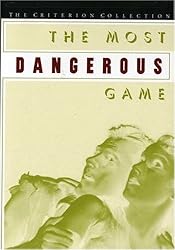
The Most Dangerous Game - Criterion Collection (1932) Review

The Most Dangerous Game - Criterion Collection (1932)
Average Reviews:

(More customer reviews)
The Most Dangerous Game is a superb early horror film. It is a really creepy, chilling film with great atmosphere. I always prefer this sort of moody horror to more modern films in the genre that depend on shocks and gore. The Most Dangerous Game can really get under your skin with its central theme of a manhunt. I had always thought, until watching the movie, that the `Game' of the title was referring to a game like Poker or Baseball, but really it is game in the sense of big game, lions and tigers and such. It is man who is `the most dangerous game.' For humans with their intellect are more of a threat to the hunter. This idea of a hunter matching his wits against a fellow human being is a deeply disturbing idea.
The film has a really fine cast. Leslie Banks plays the villain Zaroff and is suitably sinister without using histrionics. Joel McCrea shows why he would remain a leading man for the next thirty years and more. He had real star quality and a quiet acting ability similar to that of Gary Cooper. Fay Wray is delightful in a role which gives her more to do than just scream.
The Criterion DVD is very good indeed. The print is superb. There is some occasional damage, but it is hardly noticeable. The images are nearly always clear and sharp and show off the black and white photography very well. Best of all however is the sound quality. Many early talkies have terrible sound with indistinct dialogue and lots of background noise. This DVD has great sound and Criterion should really be congratulated. The DVD also has an audio commentary track by film historian Bruce Eder. His commentary is worth listening to as he is obviously enthusiastic and well informed about The Most Dangerous Game.

Click Here to see more reviews about: The Most Dangerous Game - Criterion Collection (1932)

"One of the best and most literate movies from the great days of horror," The Most Dangerous Game stars Leslie Banks as a big game hunter with a taste for the world's most exotic prey-his houseguests, played by Fay Wray and Joel McCrea. Before making history with 1933's King Kong, filmmakers Merian C. Cooper and Ernest B. Schoedsack wowed audiences with their chilling adaptation of this Richard Connell short story. Criterion is proud to present the DVD premiere of The Most Dangerous Game in a new digital transfer.

Buy NowGet 14% OFF

Click here for more information about The Most Dangerous Game - Criterion Collection (1932)

Robocop - Criterion Collection (1987) Review

Robocop - Criterion Collection (1987)
Average Reviews:

(More customer reviews)
This review is for the Blu-Ray edition. You know about the movie, so I won't rehash the plot.
As a Blu-Ray disc, this is mediocre at best. This is no posterboy for the next-gen format. The quality of the transfer is not very good. Lots of grain and not as sharp and clean as you might expect for Blu-Ray. Part of it has to do with the movie begin 20 years old, but this edition was clearly not done with TLC. It's a barebones transfer of the movie.
There are **NO** special features. The Special Features menu has two options: the Robocop trailer and Resume Movie. I don't count trailers as special features. Why even put this on the menu? Sort of silly.
No audio commentary, nada. WB didn't even include any of the features it already put on the 2 disc 20th Anniversary DVD. They could've just thrown it on here, like most other studios do by putting standard def extras onto Blu-Ray or HD DVD. If you already own the DVD version, I'd say skip this.
Buy this edition only if it's part of the BUY 1 GET 1 sale (I did) or if you must own this piece of 80's cultural memorabilia.

Click Here to see more reviews about: Robocop - Criterion Collection (1987)

Called by Ken Russell "the greatest science-fiction film since Metropolis," controversial director Paul Verhoeven's RoboCop is a special effects-laden cult phenomenon. The film features a resurrected and roboticized hero (Peter Weller) in a new, supercharged cyborg body, struggling to reclaim his memory and avenge his own death. Writtern by Edward Neumeier and Michael Miner, this film is a grown-up superhero fantasy come to vivid, bloody life.

Buy Now

Click here for more information about Robocop - Criterion Collection (1987)

Monday, November 19, 2012

The Killers - Criterion Collection (1946) Review

The Killers - Criterion Collection (1946)
Average Reviews:

(More customer reviews)
The first thing I would like to say is that "The Killers," is a superb production from the people at Criterion. Long renowned for the excellence of their titles, they really have outdone themselves this time `round. Not only do we have the two feature length versions of Hemmingway's story, from 1946 and 1964 respectively, but we have a wonderfully atmospheric audio reading of the original by Stacy Keach, a 1949 radio adaptation, AND Andriie Tarkovsky's 1956 student film version; "The Killers" x 5!!! Of the rest of the extensive "extras," the jewel in the crown is an interview with Clu Gulager, filmed in 2002, in which he tells some great stories about the 1964 production, and Lee Marvin in particular!
As much as I'm a huge fan of Film Noir, and Burt Lancaster, I have to admit I'd never even heard of the original 1946 version... shame on me! No, I bought this for the masterful Don Siegel version, staring Marvin, Gulager, Angie Dickenson, John Cassavetes, and in his only "bad guy" role, the future President of the United States of America, Ronald Reagan! Indeed, it was one of the first films I looked for on DVD when I got my shiny-disc machine, and this is somewhat surprising, as I'd only ever seen the film once, sometime back in the 70's, on British TV!
This film, especially its electrifying final scenes, featuring an incredible performance by Marvin, seared itself into my memory for the better part of 30 years, and watching it again after all this time has NOT been a disappointment! The character of hit man "Charlie Strom" was, for me, the defining image of Lee Marvin. Tough - damn, forget "tough," we're talking hard-as-nails here! - menacing, cold, logical, world weary, and brutal, when the situation warrants it. His presence drives the film, a powerhouse performance; he commands the screen every minute he's up there on it, something Clu Gulager talks about in detail. And Clu's character, "Lee," is as different from Marvin's as it's possible to get. Younger and "hipper," he wears his shades because they make him look cool, and not just to disguise his identity. He's a health nut, always ready to crack a joke, but he has a sadistic streak, he enjoys the fear he instills in people, and whereas "Strom' uses violence as a tool, "Lee" enjoys it for its own sake.
Separated by nearly 20 years in the making, the films are, in reality, light years apart in everything but the name. The 1946 version starts strong when two hit men, Max and Al, played by William Conrad - anyone remember "Cannon?!" - and Charles McGraw respectively, breeze into town, then park themselves in the local dinner. They spit out wonderfully hard-boiled Hemmingway dialogue almost verbatim from the original story, terrorize the staff, and then go off to kill "The Swede." And that is where the original story ends, and it's exactly here that the film runs out of steam, with a dogged insurance investigator, played by Edmond O'Brian, spending the next hour or so trying to piece together what happened to "The Swede." It's effectively done, using flashbacks from various characters, but in comparison to those first 15 minutes or so, it seems pretty lightweight.
Don Siegal's "The Killers," on the other hand, is altogether much stronger meat. He takes the basic premise of Hemmingway's story, a man accepting his own death at the hands of two paid hit men, and runs with it in an entirely different direction. Told entirely from the perspective of the hit men themselves, the story really takes off when Marvin's character starts to think about what just happened, why the mark, ex-racing driver "Johnny North," didn't try to escape, didn't plead for his life. "If they had a chance," he says of all his previous hits, "they ran... but he just stood there and took it." Just as the original film used the device of flashbacks to tell the story, "Strom" and "Lee" set about joining the dots as they track down the various players in this dark morality tale concerning the missing dough from a robbery, a triple-crossing dame, and a love-sick fall-guy. There isn't a wasted line of dialogue or a superfluous frame of celluloid in the whole production, every part is played to perfection, including Claude Akins as "North's" old racing partner, and a wonderfully slimy Ronald Reagan, all pomaded hair, pursed lips, and cocked eyebrow, as crime boss "Jack Browning."
Siegal's "The Killers" was planned as the original TV Movie, but, possibly, in the aftermath of JFK's assassination, the film was deemed to be too violent, the subject matter of two gunmen committing cold-blooded murder just too much for network television. By today's standards, however, the violence is minimal, although the actual hit itself is very effectively staged. But then again, what makes it work are the performances of Marvin, Gulager, and Cassavetes, and the setting, a school for the blind where "North" is a teacher; there's no graphic, blood splattered, "dance of death!"
As a piece of modern Noir, I think Siegal's "The Killers" is exemplary, as is the magnificent production from The Criterion Collection... this really IS Essential Cinema, buy it today, you won't regret it!

Click Here to see more reviews about: The Killers - Criterion Collection (1946)

Studio: Image EntertainmentRelease Date: 02/18/2003Run time: 196 minutes

Buy Now

Click here for more information about The Killers - Criterion Collection (1946)

Tuesday, October 30, 2012

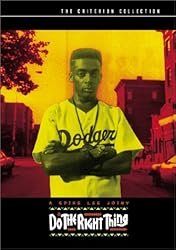
Do the Right Thing: The (The Criterion Collection) (1989) Review

Do the Right Thing: The (The Criterion Collection) (1989)
Average Reviews:

(More customer reviews)
In only his third film, Spike Lee created a classic that is both socially relevant and artistically accomplished. By focusing the actions at one location in one day, this film reminds us that race relation cannot be improved if we don't improve the way each one of us interacts with everyone else. The film's finale is notable for its echos of real events that occurred not long before the film was made, and its prescience of events to follow. It is an unforgettable movie scene that shows how intolerance can victimize everyone. Nevertheless, the apocalyptic vision of the final scene did not sit well with some critics. Is it a call to end violence or to start violence, they asked. In the film Lee seems to say there are no easy answers.
Somewhat overlooked is the fact that the film also makes keen observations of lives of American black underclass, especially in the portrayals of the "cornermen". Their exchanges are as amusing as they are trenchant in commenting the state of affairs of lower-class blacks.And through them, Lee takes the uncompromising position that sometimes the underprivileged can also be victims of their own mentalities.
Also, Lee subtlely shows the many faces of racial intolerance. While Sal's son Pino overtly hates blacks, and Buggin' Out is overtly intolerant of whites, but is the attitude of Sal himself really conducive towards racial harmony? Does he have a desire to get to know his neighbors, or does he simply want to "have no trouble with these people", as he puts it? By leaving this aspect ambiguous, Lee makes us think just what IS the right thing to do...
Despite all the criticisms against him, I believe Lee tackled the difficult subject as intelligently as any director could have done.
The Criterion DVD contains most of the supplements in the Criterion laserdisc released in 1995 -- audio commentaries, cast meetings and screen tests, 'Making Of' documentary. New supplements include Lee's press conference at the '89 Cannes festival, video interview with editor Barry Brown, "Fight the Power" music video, and a video segment showing the filmmakers re-visiting the Bed-Stuy neighborhood.
The DVD's video quality is characterized by deep, rich, saturated colors which cinamatographer Ernst Dickerson so brilliantly captured in order to create a feeling of overwhelming heat (literally and figuratively). There is a Dolby Digital 2.0 audio track (Prologic-decodable to surround), and a PCM stereo track that actually sounds brighter and crisper than the DD track.

Click Here to see more reviews about: Do the Right Thing: The (The Criterion Collection) (1989)

The hottest day of the year explodes onscreen in this vibrant look at a day in the life of Bedford-Stuyvesant, Brooklyn. Featuring a stellar ensemble cast that includes Danny Aiello, Ossie Davis, Ruby Dee, Richard Edson, Giancarlo Esposito, Robin Harris, Samuel L. Jackson, Bill Nunn, Rosie Perez, and John Turturro, Spike Lee's powerful portrait of urban racial tensions sparked controversy while earning popular and critical praise. Criterion is proud to present Do the Right Thing in a new Director Approved special edition.

Buy NowGet 27% OFF

Click here for more information about Do the Right Thing: The (The Criterion Collection) (1989)

Sunday, October 14, 2012

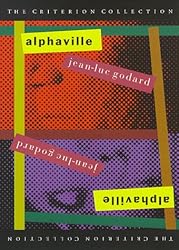
Alphaville - Criterion Collection (1965) Review

Alphaville - Criterion Collection (1965)
Average Reviews:

(More customer reviews)
Like the reviewer above, I was puzzled as to why Criterion would release this film in full frame format when everything else about the edition seemed so meticulously struck, so I thought other people might be interested in Criterion's explanation as to ask why this DVD copy was in the full frame format.
Even though Criterion released the so called widescreen edition previously (1.66:1 letterboxed), each time they re-strike a new product, they will continually consider how the specific movie is supposed to be seen. What I was told was that even though most Europeans probably saw the 1.66:1 widescreen version in the theaters when it was released, it was their belief through a lot of research and interviews, that Godard framed, and meant for the film to be in 1.33:1 - and it was the releasing company that decided on the 1.66:1 format themselves. They told me at Criterion, that neither is necessarily wrong, but that they decided to go with what they believed most suited the vision of it's maker.
I bought the DVD after hearing their explanation, and you will most likely agree with them when you view this version. From the balance of titles and words on the screen, to the way that shots are constructed (such as a sequence which is obviously intentionally composed of only gesturing hands on the edge of the frame during a conversation) I think their argument is right on the mark. Remember in this season of widescreen fever, it shouldn't be widescreen for the sake of widescreen, but to present the thing the way it was intended to be seen.

Click Here to see more reviews about: Alphaville - Criterion Collection (1965)

A cockeyed fusion of science fiction, pulp characters, and surrealist poetry, Godard's irreverent journey to the mysterious Alphaville remains one of the least conventional films of all time. Eddie Constantine stars as intergalactic hero Lemmy Caution, on a mission to kill the inventor of fascist computer Alpha 60. Criterion's edition of this seminal film features a new digital transfer.

Buy NowGet 18% OFF

Click here for more information about Alphaville - Criterion Collection (1965)

Saturday, September 29, 2012

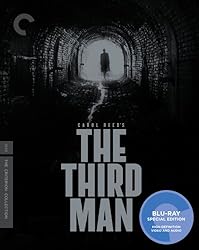
The Third Man - Criterion Collection (1949) Review

The Third Man - Criterion Collection  (1949)
Average Reviews:

(More customer reviews)
It was with great anticipation that I viewed The Third Man recently. I had last seen it nearly 25 years earlier. At the earlier viewing I was impressed with the atmospheric treatment of Vienna and the mystery surrounding Joseph Cotton's search for the truth about his friend Harry (Orson Wells). However, though I then thought of it as a very fine movie, I did not think it would rank in my top 20. Now I see what I missed as a younger person. I can also see why this film would rank as number one on a British list of greatest films of the 20th century.
The film is a surreal examination of the tension between loyalty, love, and friendship on the one hand, and truth and justice on the other. The Viennese are suffused with the cynicism of a destroyed continent and damaged culture. The British know only about the truth and justice side of the equation. The American writer of simple westerns still is naïve enough to care about friendship and truth, and follows both wherever they lead. At the same time, Carol Reed scarcely shoots a scene in which there are right angles. Nearly everything is tilted. Close-ups of faces exaggerate their features. The black and white of the film emphasizes the shadowy nature of the story and its moral underpinnings.
At first Holly Martins (Cotton) thinks he is helping his best friend, Harry Lime (Wells). At the same time he becomes Harry's rival for the woman, Anna. When Harry realizes that Holly has discovered his true evil scheme, Harry has a chance to murder Holly and make it look like an accident. What stops him? Friendship? And why does Harry accept Holly's invitation to meet? In the penultimate scene in the underground sewer tunnels, does Holly fire the final and fatal shot, or does Harry kill himself?
This magnificently filmed and wonderfully acted masterpiece has remained in my mind for days after seeing it. If you are a lover of cinema and not merely of movies, please get this classic. It richly deserves its reputation. Highly recommended.

Click Here to see more reviews about: The Third Man - Criterion Collection (1949)

Pulp novelist Holly Martins travels to shadowy, postwar Vienna, only to find himself investigating the mysterious death of an old friend, black-market opportunist Harry Lime and thus begins this legendary tale of love, deception, and murder. Thanks to brilliant performances by Joseph Cotten, Alida Valli, and Orson Welles; Anton Karas s evocative zither score; Graham Greene s razor-sharp dialogue; and Robert Krasker s dramatic use of light and shadow, The Third Man, directed by the inimitable Carol Reed, just continues to grow in stature as the years pass.

Buy Now

Click here for more information about The Third Man - Criterion Collection (1949)

Friday, September 7, 2012

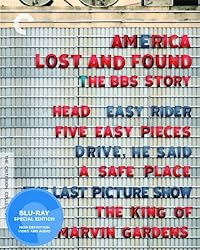
America Lost and Found: The BBS Story (Head / Easy Rider / Five Easy Pieces / Drive, He Said / The Last Picture Show / The King of Marvin Gardens / A Safe Place) (The Criterion Collection) (1972) Review

America Lost and Found: The BBS Story (Head / Easy Rider / Five Easy Pieces / Drive, He Said / The Last Picture Show / The King of Marvin Gardens / A Safe Place) (The Criterion Collection)  (1972)
Average Reviews:

(More customer reviews)
With so many surprising and great releases, I've come to take Criterion for granted. But then comes the announcement of "America Lost and Found: The BBS Story" and I'm like an excited kid on Christmas morning. Amazon has done a comprehensive job listing the contents of this impressive set, so I'm going to direct my comments at the eclectic mix of films provided. The BBS story is no less than a film revolution that occurred in the late sixties to try to foster younger artists to the industry and cultivate younger, more adventurous film goers. All films within "America Lost and Found" were produced between 1968 and 1972 and represent a challenge to the conventional film narrative of that period. In retrospect, some of the films have been proclaimed classics while others have become somewhat obsolete. But all are fascinating examples of an artistic rebellion that influenced the film industry for years to come (all the more astounding as much of the company's financing came from the funds generated by the Monkees).
My personal favorite within "America Lost and Found" is Peter Bogdanovich's "The Last Picture Show" which has been begging for a better DVD release. An evocative look at a dying small town, this gorgeous black and white film is supremely entertaining and boasts a spectacular cast. Desolate and spare, the film tells the story of Sonny and Duane who as they approach manhood must face the harsh realities of life, love, and friendship. Nominated for eight Oscars including Best Picture, the film won supporting statuettes for Ben Johnson (a career high) and Cloris Leachman. Jeff Bridges and Ellen Burstyn also received nods as did Bogdanovich for Directing and Screenplay (which he co-wrote with the incredible Larry McMurtry).
Two other undeniable classics in counterculture are Dennis Hopper's "Easy Rider" and Bob Rafelson's "Five Easy Pieces." "Easy Rider" picked up two Oscar nods (including Jack Nicholson's first) and tells the simple story of two motorcyclists' journey across America. Capturing a specific time so perfectly, the film seems to embrace the anti-establishment freedom of its leads (Hopper and Peter Fonda) while making the compelling argument that ultimate freedom is an illusion and that choosing to challenge societal norms thus becomes the norm. And "Five Easy Pieces," another of my all time favorites, was nominated for 4 Oscars (including Jack Nicholson and Karen Black). Another journey picture (both in physical travels as well as in the spiritual/psychological realm), Rafelson's landmark has one of Nicholson's most iconic performances in a film that is immensely angry and riotously funny by turn. The chicken salad sandwich scene is an undisputed classic in American cinema!
Bob Rafelson's well regarded "The King of Marvin Gardens" is also included. An underrated gem set in Atlantic City, this tale of brotherhood and dreaming big casts a realistic light on a get-rich-quick scam gone wrong. Nicholson and Burstyn are on hand, as is Bruce Dern--and this compelling quasi-masterpiece shows the three on disparate (and times desperate) paths toward redemption. Rafelson also supplies this collection with the bizarre "Head," a meandering and psychedelic excursion into the minds of The Monkees. With a documentary feel, the film follows The Monkees on numerous and random musical encounters and celebrates their celebrity while at the same time seeming to indict the culture who embraces such excesses. Jack Nicholson makes his directorial debut on the uneven "Drive, He Said"--noteworthy mostly for the Nicholson credit. Depicting the college experience in the sixties, "Drive" tells the story of a disaffected basketball player. Introducing many plot threads, the film fails to follow an effective through line and is a fairly disjointed (though interesting) effort. And lastly there is Henry Jaglom's "A Safe Place," another oddity of interior monologue with Tuesday Weld descending into a world of fantasy.
Many of the films in "America Lost and Found" share a thematic connection. The films eschew conventional plot driven narratives in favor of character study. These directors wanted to present a realistic portrait of the era in which they lived and not an idealized film world. And many of the central characters in all the works are seeking to identify their place in the modern world or, indeed, determine if they have a place at all. The BBC story, through film, is an intriguing and progressive one in that it functioned in the studio system. Independent cinema of today still reflects many of the same ideals. A must have collection for film lovers. KGHarris, 10/10.

Click Here to see more reviews about: America Lost and Found: The BBS Story (Head / Easy Rider / Five Easy Pieces / Drive, He Said / The Last Picture Show / The King of Marvin Gardens / A Safe Place) (The Criterion Collection) (1972)

Like the rest of America, Hollywood was ripe for revolution in the late sixties. Cinema attendance was down; what had once worked seemed broken. Enter Bob Rafelson, Bert Schneider, and Steve Blauner, who knew that what Hollywood needed was new audiences—namely, young people—and that meant cultivating new talent and new ideas. Fueled by money made from their invention of the superstar TV pop group the Monkees, they set off on a film-industry journey that would lead them to form BBS Productions, a company that was also a community. The innovative films produced by this team between 1968 and 1972 are collected in this box set—works created within the studio system but lifted right out of the countercultural id, and that now range from the iconic (Easy Rider, Five Easy Pieces, The Last Picture Show) to the acclaimed (The King of Marvin Gardens) to the obscure (Head; Drive, He Said; A Safe Place).Head (1968)Hey, hey, it’s the Monkees... being catapulted through one of American cinema’s most surreal '60s odysseys. In it, Mickey Dolenz, Davy Jones, Michael Nesmith, and Peter Tork become trapped in a kaleidoscopic satire that’s movie homage, media send-up, concert movie, and antiwar cry all at once. Head escaped commercial success on its release but has since been reclaimed as one of the great cult objects of its era.(85 minutes, color, monaural/surround, 1.78:1 aspect ratio)Easy Rider (1969)This is the definitive counterculture blockbuster. The former clean-cut teen star Dennis Hopper’s down-and-dirty directorial debut, Easy Rider heralded the arrival of a new voice in film, one planted firmly, angrily against the mainstream. After Easy Rider’s cross-country journey—with its radical, New Wave-style editing, outsider-rock soundtrack, revelatory performance by a young Jack Nicholson, and explosive ending—the American road trip would never be the same.(96 minutes, color, surround, 1.85:1 aspect ratio) Five Easy Pieces(1970)Jack Nicholson plays the now iconic cad Bobby Dupea, a shiftless thirtysomething oil rigger and former piano prodigy immune to any sense of romantic or familial responsibility, who returns to his childhood home to see his ailing estranged father, his blue-collar girlfriend (Karen Black, like Nicholson nominated for an Oscar) in tow. Moving in its simplicity and gritty in its textures, Bob Rafelson’s Five Easy Pieces is a lasting example of early 1970s American alienation.(98 minutes, color, monaural, 1.85:1 aspect ratio)Drive, He Said (1970)Based on the best-selling novel by Jeremy Larner, Drive, He Said is free-spirited and sobering by turns, a sketch of the exploits of a disaffected college basketball player and his increasingly radical roommate, a feverishly shot and edited snapshot of the early '70s (some of it was filmed during an actual campus protest). Jack Nicholson’s audacious comedy (starring Bruce Dern and Karen Black) is a startling howl direct from the zeitgeist.(90 minutes, color, monaural, 1.85:1 aspect ratio)A Safe Place (1971)In this delicate, introspective drama, laced with fantasy elements, Tuesday Weld stars as a fragile young woman in New York unable to reconcile her ambiguous past with her unmoored present; Orson Welles as an enchanting Central Park magician and Jack Nicholson as a mysterious ex-lover round out the cast. A Safe Place was directed by independent cinema icon Henry Jaglom.(92 minutes, color, monaural, 1.85:1 aspect ratio)The Last Picture Show (1971)The Last Picture Show is one of the key films of the American cinema renaissance of the '70s. Set during the early '50s in the loneliest Texas nowheresville to ever dust up a movie screen, this aching portrait of a dying West, adapted from Larry McMurtry’s novel, focuses on the daily shuffles of three futureless teens—enigmatic Sonny (Timothy Bottoms),(Jeff Bridges), and desperate-to-be-adored rich girl Jacy (Cybil Shepherd)—and the aging lost souls who bump up against them in the night like drifting tumbleweeds. This hushed depiction of crumbling American values remains the pivotal film in the career of the invaluable director and film historian Peter Bogdanovich.(126 minutes, black and white, monaural, 1.85:1 aspect ratio)The King of Marvin Gardens (1972)For his electrifying follow-up to the smash success of Five Easy Pieces, Bob Rafelson dug even deeper into the crushed dreams of wayward America. Jack Nicholson and Bruce Dern play estranged siblings David and Jason, the former a depressive late-night radio talk show host, the latter an extroverted con man; when Jason drags his younger brother to a dreary Atlantic City and into a real-estate scam, events spiral into tragedy. (104 minutes, color, monaural, 1.85:1 aspect ratio)

Buy NowGet 28% OFF

Click here for more information about America Lost and Found: The BBS Story (Head / Easy Rider / Five Easy Pieces / Drive, He Said / The Last Picture Show / The King of Marvin Gardens / A Safe Place) (The Criterion Collection) (1972)

Tuesday, July 31, 2012

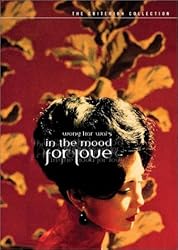
In the Mood for Love - Criterion Collection (2000) Review

In the Mood for Love - Criterion Collection (2000)
Average Reviews:

(More customer reviews)
Perfection in cinema is an almost impossible goal to achieve. Mostly because spectators have varying taste and perspectives. But you can't help but feel that Wong Kar-Wai's "In the Mood for Love" is anything short of perfection. The imagery with its lush colors and breathtaking movements is enough to elevate this film. The simple, yet somewhat complicated tale is both heartfelt and authentic. And the performances by Tony Leung and Maggie Cheung are a marvel. But it's none of these that really makes this film, it's rather the manner that Kar-Wai so magically molds all these factors to set a mood that I have never felt before while watching a movie. In all honesty, I'm really not too fond of "forbidden love" movies, but this film really startled me.
Ironically, "In the Mood for Love" feels nothing like a Wong Kar-Wai film. It's a very slow moving film which uses lots of fades and dissolves. The Criterion edition of this film is probably the best dvd package I've seen to date. There are just so many extras on it, it's hard to believe. Deleted scenes, interviews, and promotional material, are just a few of the extras. The way Kar-Wai shoots his films (without a script) also adds to the suprise of picture. You see in the extras how much different the original concept was for "In the Mood for Love." There is also an alternate ending that seems very plain, but at the same time very heartbreaking.

Click Here to see more reviews about: In the Mood for Love - Criterion Collection (2000)

Hong Kong, 1962: Chow Mo-wan and Su Li-zhen move into neighboring apartments on the same day. Their encounters are polite and formal-until a discovery about their respective spouses sparks an intimate bond. At once delicately mannered and visually stunning, Wong Kar-wai's In the Mood for Love is a masterful evocation of romantic longing and fleeting moments in time.

Buy NowGet 6% OFF

Click here for more information about In the Mood for Love - Criterion Collection (2000)

Friday, July 27, 2012

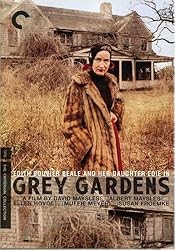
Grey Gardens - Criterion Collection (1976) Review

Grey Gardens - Criterion Collection (1976)
Average Reviews:

(More customer reviews)
"Grey Gardens" is a one-of-a-kind documentary exploring a mother-daughter relationship. These aren't just two anonymous people though; instead, the film chronicles Edith Bouvier Beale and her daughter, "Little Edie," who just happen to be the aunt and cousin of Jackie Kennedy Onassis. The filmmakers, Albert and David Maysles, initially intended the film to be about Jackie's sister, Lee Radziwill. However, after being introduced to Edith and Little Edie by Lee, they decided to shift the focus.
What makes these two women so interesting? First, they live in a giant decaying mansion (the titular "Grey Gardens") in luxurious East Hampton. The family was extremely wealthy at one time, until Edith divorced and lost most of her money. She apparently stayed in the 28-room Grey Gardens mansion despite a lack of money for upkeep. The women show pictures of themselves from years earlier, and they were obviously beautiful society scions. However, they became more and more isolated from society as they hunkered down into their mansion At one point, the mansion was even raided by East Hampton officials, who wanted to evict the pair due to the unsanitary living conditions. Jackie subsequently helped them clean up the mansion.
All of this action, though, occurs before the film starts in 1975 (some of the back story is presented in pictures and newspaper stories). In fact, in the documentary, not much new happens: the women continue their bizarre existence in the mansion and argue. They argue a lot. Every conversation is filled with their remembrances of better times, when Little Edie was desired by wealthy men and Edith carried on an affair with a pianist. This life is so far removed from their current surroundings, and their regrets about that disparity quickly surface. Apparently, Little Edie had been living in NYC in the 1950s, before her mother had her come back home to take care of her. This arrangement was only supposed to be for a short time, but 24 years later, they are still at Grey Gardens and arguing.
Although the movie focuses on relatives of a very famous woman, the themes of living in the past and experiencing regret are so universal. The women have in many ways a typical mother-daughter relationship, but it's also so atypical. Quite simply, they live a rather deluded existence, arguing so passionately about past events as though it still mattered or was in the present. Neverthless, the women are fascinating on so many levels, including Edie's fashion style. Throughout the film, Edie models numerous outfits that she's created, all accompanied by a turban. Whether she's bald or just loves turbans is never explored. Funnily, Edie's bizarre style has become somewhat of an ironic fashion inspiration; the DVD even features Todd Oldham explaining that he has actually used Edie's fashion sense while designing a number of outfits!
Some people have criticized this documentary for a variety of reason, including calling the filmmakers exploitative. I don't think that the Beales were exploited - they are both intelligent although somewhat deluded women and likely understood the implications of participating in this filming. Others have said that the material is somewhat suspect - are the Beales "worthy" of a documentary? That's a judgment call each viewer will need to make. I enjoyed it - the film is like nothing else I've ever seen. Although the Beales are deluded at times, their relationship is like a Tennessee Williams play sprung to life! I wasn't able to turn away, and I know that these women will stick with me for a long time. Most highly recommended.
The DVD extras include original trailers and a fascinating commentary track featuring the Maysles and their associates. They fill in many of the blanks about the film. Fortunately, the DVD includes subtitles, as the women constantly talk over each other during their arguments. You needn't miss a single word of this hypnotic documentary.

Click Here to see more reviews about: Grey Gardens - Criterion Collection (1976)

Meet Big and Little Edie Beale-high society dropouts, mother and daughter, reclusive cousins of Jackie O.-thriving together amid the decay and disorder of their ramshackle East Hampton mansion. Five years after Gimme Shelter, the Maysles unveiled this impossibly intimate portrait of the unexpected, an eerie echo of the Kennedy Camelot, which has since become a cult classic and established Little Edie as fashion icon and philosopher queen.

Buy Now

Click here for more information about Grey Gardens - Criterion Collection (1976)

Saturday, July 7, 2012

Zabriskie Point (2009) Review

Zabriskie Point (2009)
Average Reviews:

(More customer reviews)
I give this move 5 stars for personal reasons. If you peer ever so closely at the panoramic 'orgy in the desert' shot, you will see me groaning with "her" in the sand. While there was no actual fornicating going on within my range of vision, I can tell you the gal next to me was asking out loud for it! Damn! I miss those incredibly naive, self-indulgent days. It was, I believe, October of 1968 and I was a senior in a Las Vegas high school. I answered the casting call for extras. Miracously, my father allowed me to miss a week of school to "train" with a feely-touchy dance troupe from NY. When shooting started MGM would bus us from Vegas to the Point every morning at 5am. Most of my time on the set was spent gawking at Diana, Antonioni, and all the wild movie equipment. They even imported fine silk sand to blow around. I guess Death Valley sand was not european enough. I remember Antonioni, in full archetypical director mode, chasing Mark F. off the sound set for laughing at our feeble attempts to create "love noises" for the orgy scene. HA! The setting was surreal, the weather incredible, the catered lunch edible, and the young ladies sensuous and willing in that 60's way. You know how you sometimes fantasize about going back to a time in your life that was almost perfect? Well, this is one of those times for me.
Oh, I read the Time Magazine review when the movie came out and the reviewer said, "The moral of the story? Don't help a good boy go bad. Lock your airplane, take your keys." Since I wrote that "review" back in 1991 I had occasion to revisit Zabriskie's Point (the place, not the movie). It was my 50th birthday and my wife treated me to a stay at the famous Furnace Creek Inn.
We went over and it was as I remember it. Stunning. The only change was the parking/view area. You can no longer just drive on in to the canyons as the catering truck did back in 1968. So, while I am 'pointing and pondering' these three beautiful ladies arrive. They are talking away in some Euro language and I hear, "Antonioni". I say, "you know the movie?"
"Yes, we came to Death Valley just to see this place."
I say, "I was there when the movie was filmed".
They all came unglued and plied me with questions. Had to have a photo. My wife was bemused, to say the least. For a moment, I was once again Making Love, Not War.
I am just realizing what an effect this movie has had on so many people and how lucky I was to be even a small part of it.
The real miracle of it all is that my father let a 17 year old wanna-be hippie skip a week of school to bounce around Death Valley with a bunch of radicals. Another odd thing was that I had recently sworn off drugs and alcohol so I got to be totally "present" for the experience. From my observation, I may have been the only sober participant...!

Click Here to see more reviews about: Zabriskie Point (2009)

In a story of youthful rebellion, a young man steals an airplane and flies over the desert, where he meets a young woman and falls in love.

Buy NowGet 20% OFF

Click here for more information about Zabriskie Point (2009)

Thursday, April 26, 2012

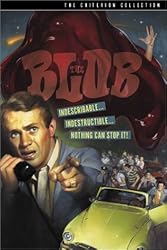
The Blob - Criterion Collection (1958) Review

The Blob - Criterion Collection (1958)
Average Reviews:

(More customer reviews)
When I saw that the CRITERION COLLECTION was bringing THE BLOB to DVD - I have to admit I was shocked. This effective and classy little 1950's monster flick was getting the kind of star treatment that most films released on DVD are begging for. And for good reason... THE BLOB is an excellent movie. It hits all the marks, it stands it grounds, it never bores you and it provides you with a original (and even credible) monster that to this day is still more sinister than most that cross the screen (and yet remains the most fun - really, if gum chewed back, it would look like the BLOB). CRITERION again shines here... period style box art (including in the lower left corner a warning that the producers of THE BLOB can not be held libal for heart attacks or faninting from watching the film), a fact based booklet featuring the orginal poster art from the release for it's cover, plus a half sheet poster of the box art that is high quality and all glossy... a beautiful touch. The disc features an excellent transfer of the film. The colors are crisp and the sound is still effective and well balanced. Two audio commentaries are included with the disc, and each are insightful and entertaining. Both remain pretty much screen specific, but do branch out from time to time to explain a host of inside details (like why McQueen wished had had taken a percentage of THE BLOB, and how the leading lady wasn't cast until the very last second... which was the very first day of shooting). Trailer is included, as well as what is really a excellent addition... a photo collection of behind the scene stills, effects (even what the real BLOB looked like off camera and just how big it really was... little hint: not very), and rare BLOB props and BLOB memorabilia - overall CRITERION has given us yet another must have for DVD owners. If you're a fan of the period and the genre, then THE BLOB is a must, I can not recommend it enough... it's pure fun. And if you know someone this holiday season that is getting a DVD and into 50's shockers... start them off right and pick up the BLOB.

Click Here to see more reviews about: The Blob - Criterion Collection (1958)

"Beware of the Blob!" One of the great cult classics, The Blob melds '50s schlock sci-fi and teen delinquency pics even as it transcends these genres with strong performances and ingenious special effects. Made outside of Hollywood by a maverick film distributor, a crew experienced in religious and educational shorts, and a collection of theatrical talent from Philadelphia and New York, The Blob helped launch the careers of superstud Steve McQueen and composer Burt Bacharach.

Buy NowGet 22% OFF

Click here for more information about The Blob - Criterion Collection (1958)